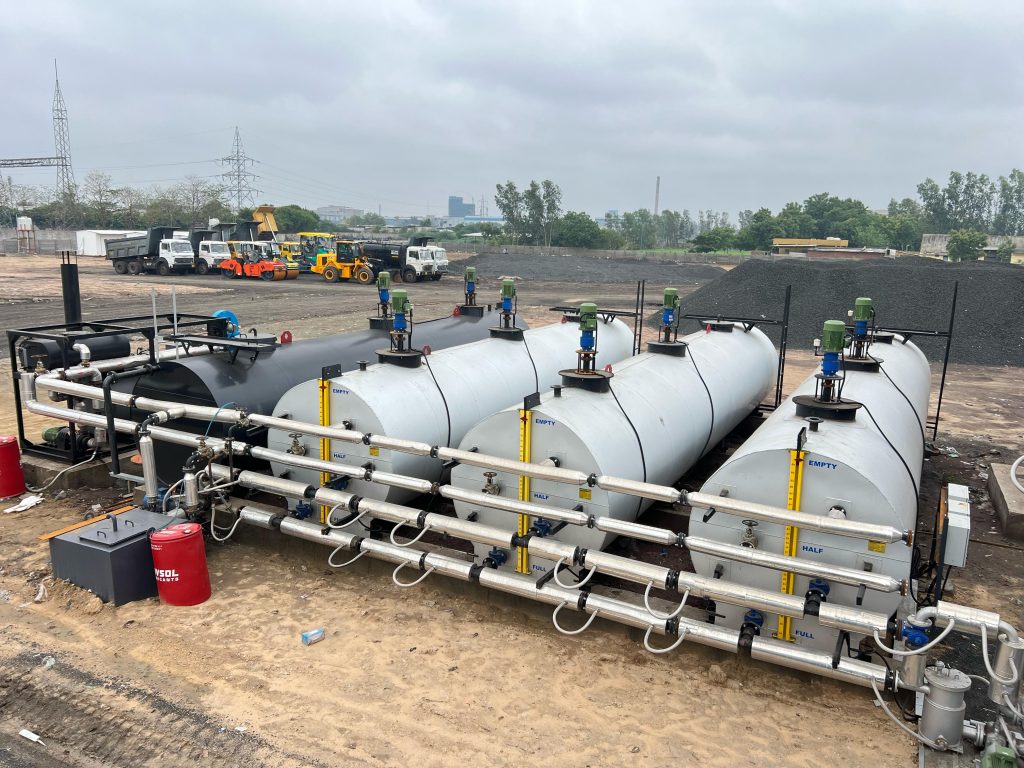
A Bitumen Storage & Heating Tank is used to store bitumen and maintain it at a controlled temperature so that it remains sufficiently fluid for pumping, transfer, mixing, or further processing. Available in Direct Heating and Indirect Heating arrangements, with capacities of 20, 30, 50, 75, and 100 KL to suit every scale of operation.
CAPACITY (KL)
20 / 30 / 50 / 75 / 100
HEATING TYPE
Direct / Indirect
MEDIUM
Burner / Thermic Fluid
A Bitumen Storage & Heating Tank is used to store bitumen and maintain it at a controlled temperature so that it remains sufficiently fluid for pumping, transfer, mixing, or further processing. There are two main heating arrangements — Direct Heating Type and Indirect Heating Type.
In a direct‑heating tank, heat is supplied directly to the bitumen through a burner/flame or a direct‑fired heating arrangement.
In an indirect‑heating tank, the bitumen is heated through a heating medium such as thermic fluid or steam. The heating medium circulates through coils or a heat exchanger without directly contacting the bitumen.
In a direct‑heating tank, heat is supplied directly to the bitumen through a burner/flame or a direct‑fired heating arrangement.
| Component | Function |
|---|---|
| Storage Tank | Stores bitumen |
| Burner | Generates heat |
| Heating Chamber/Tube | Transfers heat directly to bitumen |
| Temperature Sensor | Controls bitumen temperature |
| Level Indicator | Indicates tank level |
| Insulation | Reduces heat loss |
| Pump | Transfers hot bitumen |
| Control Panel | Controls burner and temperature |
| Vent | Provides safe vapour/air outlet |
For higher‑quality bitumen processing, direct flame contact with the product should generally be avoided unless the system is specifically engineered for that service.
In an indirect‑heating tank, the bitumen is heated through a heating medium such as thermic fluid or steam. The heating medium circulates through coils or a heat exchanger without directly contacting the bitumen.
| Component | Function |
|---|---|
| Storage Tank | Stores bitumen |
| Heating Coil | Transfers heat to bitumen |
| Thermic Fluid Heater | Heats thermal oil |
| Circulation Pump | Circulates thermic fluid |
| Expansion Tank | Accommodates thermal‑fluid expansion |
| Temperature Sensors | Monitors and controls temperature |
| Insulation | Minimizes heat loss |
| Bitumen Pump | Transfers heated bitumen |
| Level Instrument | Measures tank level |
| Control Panel/PLC | Automatic temperature and pump control |
Direct heating offers fast heat‑up times with a simple burner arrangement — suitable for small or temporary installations where speed is critical.
Thermic fluid heating coils provide uniform temperature distribution across the tank, preventing localized overheating — ideal for continuous industrial operation.
A single thermic‑fluid heating system can serve multiple tanks, reducing overall equipment cost and simplifying plant design.
Direct heating has a lower upfront equipment cost, making it a practical choice for budget‑conscious small‑scale operations.
Heavy‑duty mineral wool insulation with aluminum cladding minimizes heat loss and reduces energy consumption for both heating types.
On‑site commissioning, maintenance training, and spare parts support across 32 countries.
Indirect heating tanks are well suited for continuous industrial bitumen storage and processing operations.
Direct heating tanks suit small or temporary sites where fast heating and low initial cost are priorities.
Part of integrated tank farms for bulk bitumen storage and distribution, available in 20 to 100 KL capacities.
Keeps bitumen sufficiently fluid for pumping, transfer, mixing, or further downstream processing.
The tank is available in 20 KL, 30 KL, 50 KL, 75 KL, and 100 KL capacities.
In direct heating, a burner/flame heats the bitumen directly. In indirect heating, a heating medium such as thermic fluid or steam circulates through coils and heats the bitumen without direct flame contact, giving more uniform temperature control.
Indirect heating is generally preferred for continuous industrial operation, since it offers uniform heating, better temperature control, and can serve multiple tanks from a single thermic fluid heater.
For higher‑quality bitumen processing, direct flame contact with the product should generally be avoided unless the system is specifically engineered for that service.
Yes, the tank is designed with standard flanged connections for easy integration with bitumen plants, loading systems, and distribution networks.
Get a tailored quote for your capacity, heating type, and site requirements.