Home chevron_right Products chevron_right Bitumen Modification chevron_right PMB/CRMB Modifying Plant
PMB/CRMB BITUMEN MODIFY PLANT
BITUMEN MODIFICATION

PMB/CRMB BITUMEN MODIFY PLANT

A high-shear blending and dispersion plant used to modify paving bitumen with polymers (SBS, SBR, EVA) or crumb rubber, improving rutting resistance, elasticity, fatigue resistance, temperature resistance, and durability. In India, PMB is covered under IS 15462:2019, while rubber-modified bitumen is covered under IS 17079:2019. Capacities from 10 to 40 TPH.

verified ISO 9001:2015 bolt High Shear Mixing history 20+ Year Lifespan public Exported to 28 Countries

CAPACITY

10–40 TPH

MODIFICATION TYPE

PMB / CRMB

POWER

30–90 kW

support_agent Need a custom formulation? Talk to our engineers →
Overview
Technical Specifications
PMB & CRMB Grades
Features & Benefits
Applications
FAQs

Superior Road Durability Through Advanced Modification

A PMB/CRMB Bitumen Modification Plant is a high-shear blending and dispersion plant used to modify paving bitumen with polymers or crumb rubber to improve rutting resistance, elasticity, fatigue resistance, temperature resistance, and durability. In India, PMB is covered by IS 15462:2019, while rubber-modified bitumen is covered separately by IS 17079:2019. BIS currently lists PMB grades PMB 64‑10, 70‑10, 76‑10, 82‑10 and 76‑22 under IS 15462:2019.

settings 1. PMB Plant — Polymer Modified Bitumen

Basic process:

Base bitumen → Heating → Polymer dosing → High-shear mixing → Development/conditioning tank → Storage → Finished PMB

Typical polymers include SBS, SBR, EVA and other compatible polymer modifiers. Selection depends on the required performance grade and application. A proper PMB plant needs a high-shear dispersion system because homogeneous polymer dispersion is critical to final binder performance. BIS testing requirements include homogeneity and separation/degradation-related checks.

inventory Main PMB Plant Equipment

Equipment Typical Function
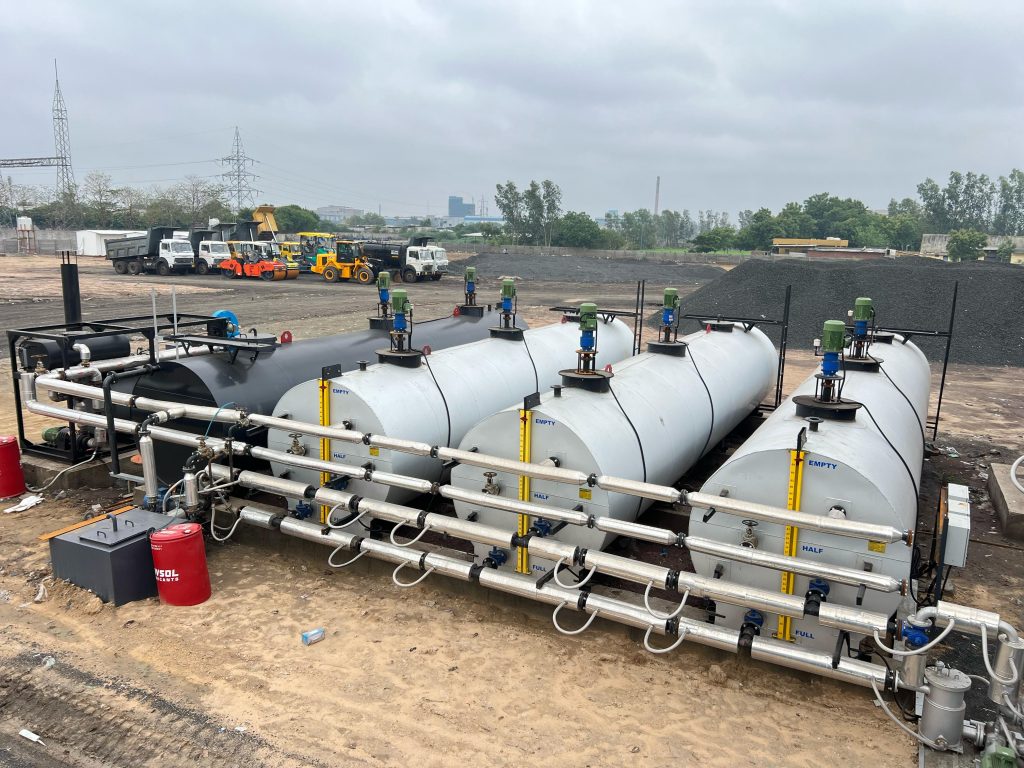
Base BITUMEN TANK Stores VG-grade base bitumen
Bitumen Transfer Pump Transfers hot bitumen
Bitumen Heating System Maintains required processing temperature
Polymer Storage/Hopper Stores polymer
Polymer Feeding System Controlled polymer dosing
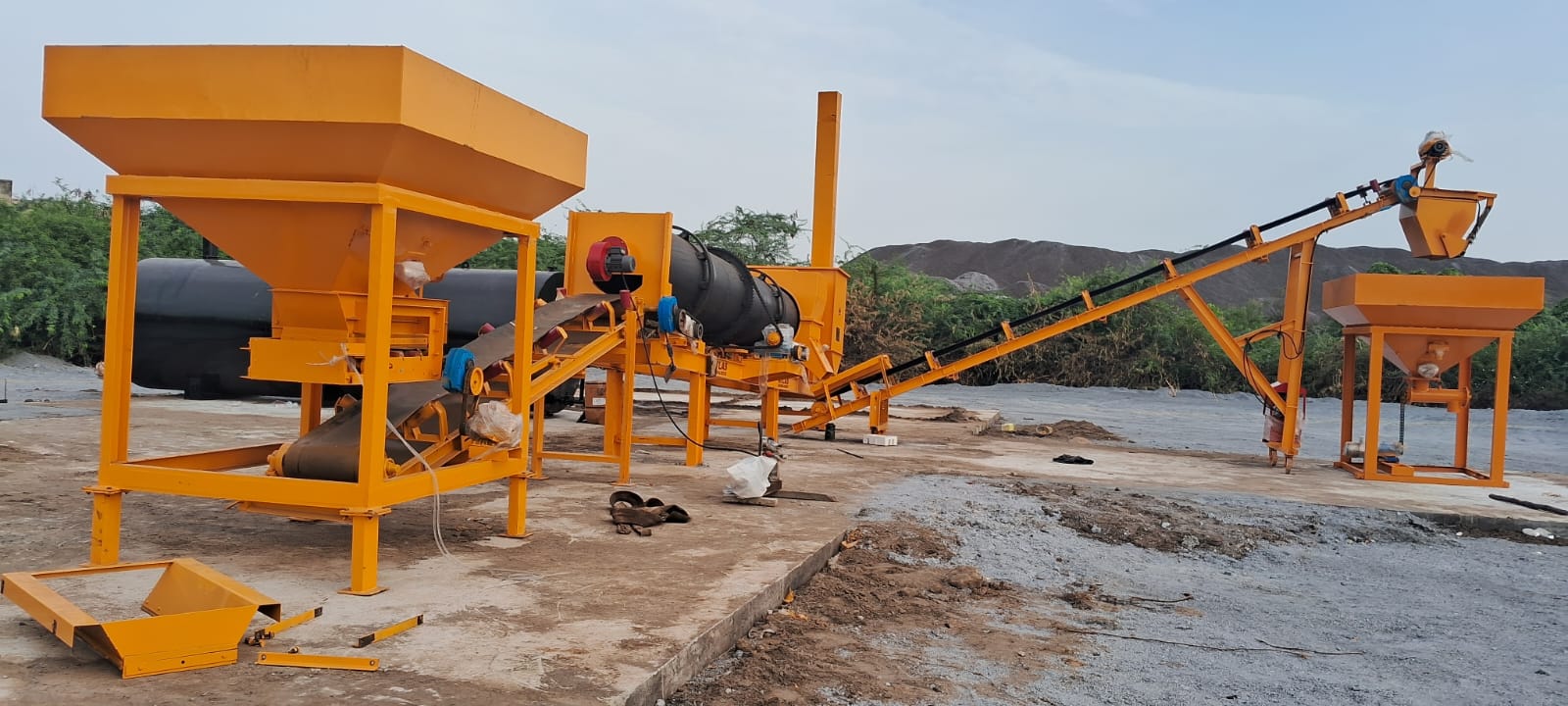
High-Shear Mixer / A 4. COLD MIX ASPHALT PLANT (FOR MONSOON POTHOLE REPAIR WORK) Disperses polymer into bitumen
Modification/Reaction Tank Polymer swelling and development
Recirculation Pump Continuous circulation
Finished Product Tank Stores finished PMB
Thermic Fluid Heater Heating of tanks and pipelines
Electrical/PLC Panel Automatic plant control
Piping & Valves Bitumen/polymer circulation
Sampling System Quality-control sampling
Laboratory Equipment PMB quality testing

recycling 3. CRMB Plant — Crumb Rubber Modified Bitumen

CRMB is different from conventional PMB because the principal modifier is crumb rubber, normally obtained from processed waste tyres. The Indian specification is IS 17079:2019 Rubber Modified Bitumen (RMB). BIS testing information identifies CRMB 55 and CRMB 60 under Type B CRMB.

Basic CRMB process:

Base bitumen → Heating → Crumb rubber dosing → High-shear mixing → Digestion/development → Recirculation → Storage → CRMB

The rubber must be adequately dispersed/swollen in the hot bitumen to obtain the required properties.

device_hub 6. Recommended PMB/CRMB Plant Configuration

For a commercial plant, a combined PMB + CRMB modification plant is recommended rather than two completely independent plants.

BASE BITUMEN TANKS → BITUMEN PUMP →

├── PMB MODIFIER SYSTEM ──┐

├── CRUMB RUBBER SYSTEM ──┘

→ HIGH-SHEAR MIXING SYSTEM → DEVELOPMENT/REACTION → RECIRCULATION SYSTEM → FINISHED PRODUCT TANK → LOADING/DISPATCH

For PMB production, separate polymer dosing and high-shear dispersion equipment is provided. For CRMB, rubber feeding, digestion/development and recirculation equipment is provided.

stacked_bar_chart 7. Example Plant Capacities

Plant Capacity Approx. Production
Small 5 TPH
Medium 10 TPH
Large 15 TPH
High Capacity 20 TPH

For a 10 TPH PMB/CRMB plant, the system can be designed around approximately 10 tonnes/hour finished modified bitumen production, subject to the required grade, polymer/rubber dosage, mixing time and development time.

build Typical Major Equipment for a 10 TPH Plant

  • 2 × base bitumen storage tanks
  • 1 × PMB premix/modification tank
  • 1 × CRMB reaction/development tank
  • 1 × finished-product tank
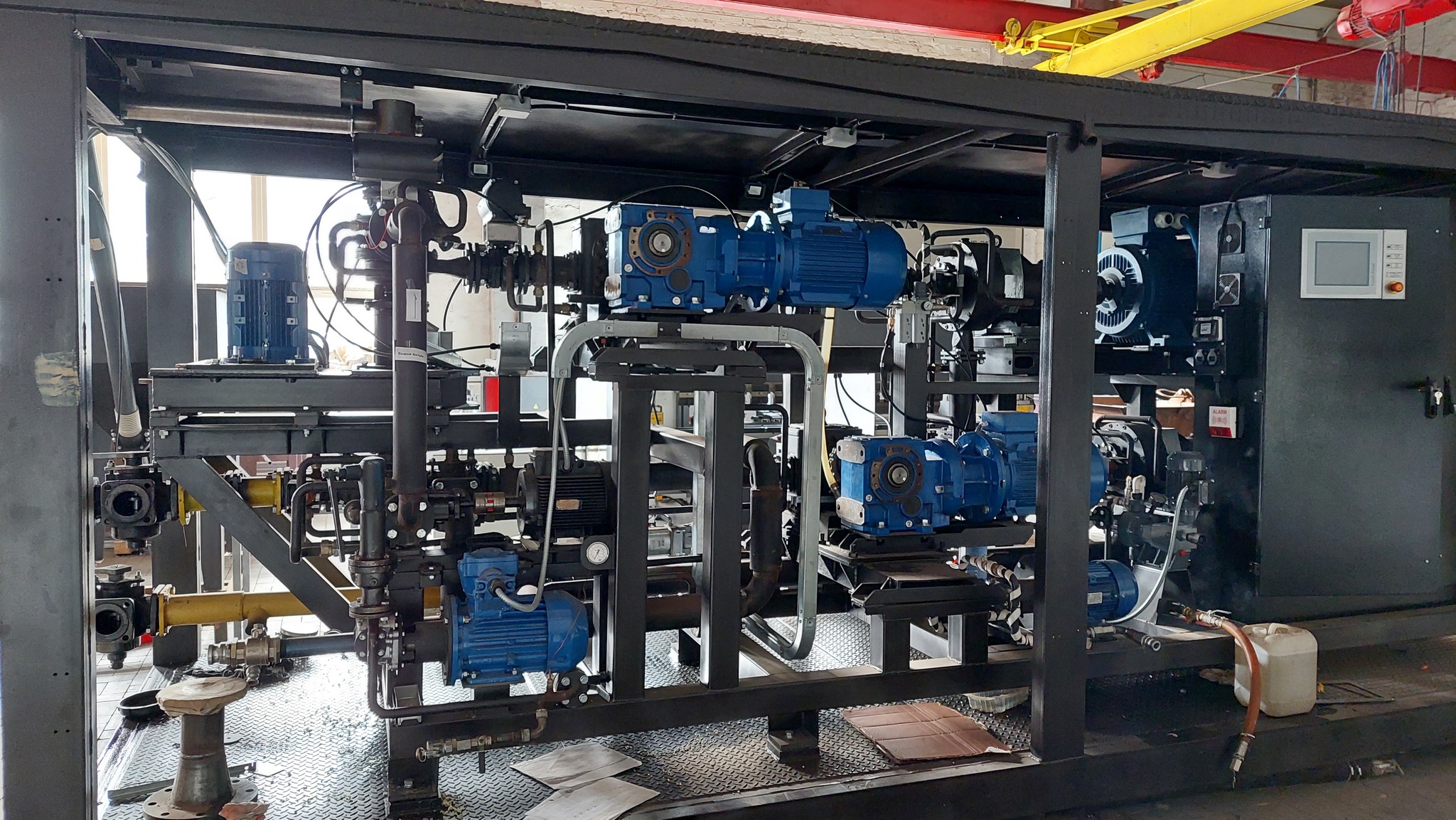
  • 1 × high-shear colloid/homogenizer system
  • Bitumen transfer/recirculation pumps
  • Polymer dosing system
  • Crumb-rubber feeding system
  • Thermic-fluid heater
  • Hot-oil circulation system
  • Insulated/heated pipelines
  • Automatic valves
  • PLC + HMI/SCADA
  • Load cells/flow meters
  • Temperature and pressure instrumentation
  • Sampling points
  • Finished-product loading system

Important design point: PMB and CRMB should not simply be treated as the same process with different additives — mixing, dispersion, development time, storage and quality-control requirements differ between the two.

inventory_2 Quick Facts

BrandAtlas Engineering
OriginAhmedabad, India
Warranty18 Months
Delivery8–10 Weeks
PMB StandardIS 15462:2019
CRMB StandardIS 17079:2019
SpecificationDetails
Capacity10 TPH / 15 TPH / 20 TPH / 30 TPH / 40 TPH
Modification TypePMB (SBS, SBR, EVA) / CRMB (crumb rubber)
Milling SystemHigh-shear colloidal mill
Bitumen HeatingThermic fluid, up to 190°C
Polymer/Rubber DosingAutomated screw feeder + PLC control
Power Requirement30–90 kW (model dependent)
Storage Tank Capacity10,000–60,000 Litres
Control SystemPLC + HMI Touchscreen / SCADA
ComplianceIS 15462:2019 (PMB), IS 17079:2019 (CRMB), MoRTH
FootprintApprox. 40 ft x 25 ft (10 TPH)
Net Weight5,000–12,000 kg (model dependent)
Main EquipmentBase tanks, transfer pumps, polymer/rubber feeding, high-shear mill, reaction tanks, recirculation pumps, finished tanks, thermic heater, PLC panel

PMB vs CRMB — Quick Comparison

Parameter PMB CRMB
Modifier Polymer Crumb rubber
Common modifier SBS/SBR/EVA etc. Waste-tyre crumb rubber
Main standard IS 15462:2019 IS 17079:2019
Typical grades PMB 64-10 to 82-10, PMB 76-22 CRMB 55, CRMB 60
Main advantage Controlled performance characteristics Elasticity, durability and recycling benefit
Equipment High-shear polymer mixer High-shear rubber mixing/digestion system
Storage Requires controlled temperature/recirculation Generally requires stronger agitation/recirculation
Typical market Expressways, highways, high-performance pavements Highways, heavy-duty roads, surface treatments

PMB Grades under IS 15462:2019

The current Indian performance-based PMB specification includes five principal grades. The numbers are performance-temperature designations, not penetration grades — the first number relates to the upper pavement-temperature requirement and the second to the lower temperature requirement. IRC guidance states that PMB selection for different service conditions should follow IS 15462:2019.

PMB Grade Temperature Basis Typical Application
PMB 64-10 Moderate-high pavement temperature General highways, urban roads
PMB 70-10 Higher pavement temperature High-temperature/high-traffic roads
PMB 76-10 Very high pavement temperature Heavy traffic, expressways
PMB 82-10 Extremely high pavement temperature Very heavy/extreme traffic and high-temperature locations
PMB 76-22 High maximum + very low minimum temperature High-altitude/cold-climate areas

The actual grade should be selected based on the project's pavement-temperature and traffic requirements, rather than simply choosing the strongest grade.

Typical PMB Application Logic

PMB 64-10General road construction, urban roads, moderate traffic, conventional bituminous pavement.
PMB 70-10National/state highways, heavy traffic, hotter pavement conditions, bus/truck routes.
PMB 76-10Expressways, heavy and very heavy traffic, high-temperature pavement, areas susceptible to rutting.
PMB 82-10Extremely heavy traffic, very high pavement temperatures, special high-performance pavement applications.
PMB 76-22High-altitude areas, cold climatic conditions, pavements requiring both high-temperature rut resistance and low-temperature cracking resistance.

CRMB Grades

Earlier/common specifications also refer to CRMB 50, CRMB 55 and CRMB 60 classifications, with the grade number corresponding to minimum softening point.

Grade Minimum Softening Point Typical Application
CRMB 55 55°C Heavy-duty road applications, surface treatments
CRMB 60 60°C Higher-temperature/heavier-duty applications
CRMB 55 — Suitable for:
  • Highway construction
  • Heavy traffic roads
  • Flexible pavement
  • Surface dressing
  • Bituminous mixes
  • Roads requiring improved resistance to rutting and cracking
CRMB 60 — Used where higher-temperature performance is required:
  • Heavy and very heavy traffic
  • Hot climatic conditions
  • Expressways/highways
  • Pavements requiring greater resistance to permanent deformation
precision_manufacturing

High‑Shear Colloidal Mill

Advanced wet‑milling ensures complete homogenization of SBS, SBR, EVA polymers and crumb rubber into bitumen — homogeneous dispersion is critical to final binder performance.

science

Precise Polymer / Rubber Dosing

Automated feeders and PLC control guarantee consistent modifier content across all batches, meeting BIS homogeneity requirements.

swap_horiz

Dual‑Purpose PMB + CRMB

Combined plant configuration with separate PMB and CRMB modifier systems feeding into a shared high-shear mixing and development line.

memory

PLC + HMI/SCADA Control

Automatic monitoring of load cells, flow meters, temperature and pressure instrumentation for consistent quality batch after batch.

thermostat

Advanced Temperature Control

Thermic fluid heating with hot-oil circulation ensures optimal polymer activation and crumb rubber digestion.

support_agent

24/7 Technical Support

On‑site commissioning, formulation assistance, and spare parts support across 28 countries.

route

Highways & Expressways

PMB 70-10/76-10 grades for heavy-traffic national highways, bus/truck routes, and expressways requiring superior rutting resistance.

flight_takeoff

Extreme / Special-Performance Pavements

PMB 82-10 for extremely heavy traffic and very high pavement temperatures.

terrain

High‑Altitude / Cold Climates

PMB 76‑22 for high-altitude and cold climatic areas requiring both rut resistance and low-temperature crack resistance.

foundation

Heavy Traffic / Flexible Pavement

CRMB 55 for highway construction, heavy traffic roads, surface dressing, and bituminous mixes.

device_thermostat

Hot Climate / Heavy Duty Roads

CRMB 60 for heavy and very heavy traffic, hot climatic conditions, expressways and highways.

recycling

Sustainable CRMB

Crumb rubber from waste tyres, contributing to circular economy and enhanced binder elasticity.

What is a PMB/CRMB Bitumen Modification Plant?expand_more

It is a high-shear blending and dispersion plant used to modify paving bitumen with polymers or crumb rubber to improve rutting resistance, elasticity, fatigue resistance, temperature resistance and durability.

What polymers can this plant process?expand_more

The plant can process SBS (Styrene-Butadiene-Styrene), SBR (Styrene-Butadiene Rubber), EVA (Ethylene-Vinyl Acetate), and other compatible polymer modifiers. It also processes crumb rubber for CRMB production.

What are the available PMB grades?expand_more

Under IS 15462:2019, available grades are PMB 64-10, PMB 70-10, PMB 76-10, PMB 82-10, and PMB 76-22. Selection depends on pavement temperature and traffic conditions rather than simply choosing the strongest grade.

What is CRMB and what grades are available?expand_more

CRMB (Crumb Rubber Modified Bitumen) uses recycled tyre rubber as the modifier, covered under IS 17079:2019. BIS testing identifies CRMB 55 and CRMB 60 (Type B CRMB), with minimum softening points of 55°C and 60°C respectively.

Can the plant produce both PMB and CRMB?expand_more

Yes — a combined PMB + CRMB configuration is recommended over two independent plants, with separate polymer and crumb-rubber dosing systems feeding a shared high-shear mixing, development and recirculation line.

What is the typical capacity range?expand_more

Standard capacities range from 10 TPH to 40 TPH (small: 5 TPH, medium: 10 TPH, large: 15 TPH, high capacity: 20 TPH+), with options for custom capacities based on project requirements.

What equipment does a typical 10 TPH plant include?expand_more

Base bitumen storage tanks, PMB premix/modification tank, CRMB reaction/development tank, finished-product tank, high-shear colloid/homogenizer system, transfer/recirculation pumps, polymer dosing system, crumb-rubber feeding system, thermic-fluid heater, PLC + HMI/SCADA, instrumentation, and a finished-product loading system.

Are PMB and CRMB processed the same way?expand_more

No. PMB and CRMB should not be treated as the same process with different additives — their mixing, dispersion, development time, storage and quality-control requirements are different.

What is the typical delivery time?expand_more

Standard units are delivered in 8–10 weeks from order confirmation, with on-site commissioning and formulation training included.

Related Products

Ready to upgrade your bitumen?

Get a tailored quote for your polymer/rubber modification capacity and formulation requirements.

Request a Quote arrow_forward
chat
payments Request Quote
headset_mic Live Chat